 EN
EN

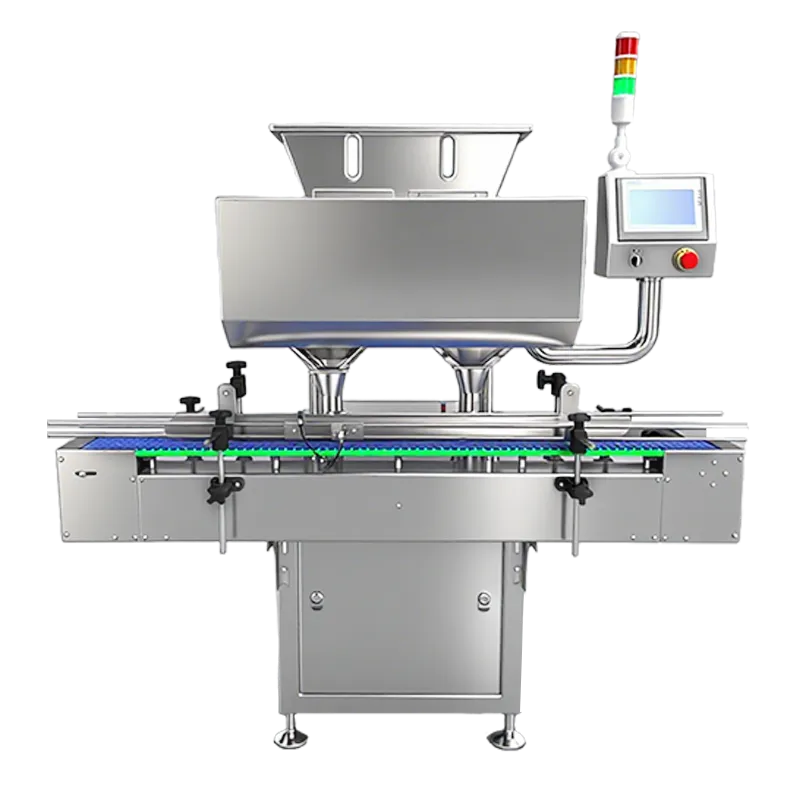
How Automatic Counting Machines Work: The Core Principle
At its simplest, an automatic counting machine takes a bulk supply of tablets, capsules, or similar solid-dose products, singulates them into a controlled single-file stream, passes each unit past a detection sensor that registers its presence, and accumulates the count until the preset fill quantity is reached — at which point the batch is discharged into a waiting bottle, blister cavity, or pouch, and the cycle repeats. This cycle, from detection to discharge, occurs in as little as 0.4 seconds in a modern high-speed counting line processing 150 bottles per minute.
The apparent simplicity of this process belies the precision engineering required to make it reliable at pharmaceutical production scales. A single counting machine in a mid-volume facility might process 50 million tablets per year. At an accuracy requirement of ±0.1%, this translates to no more than 50,000 miscounts across the entire annual output — and in practice, modern machines from manufacturers like Hangzhou Ruiyi Machinery Technology Co., Ltd. routinely exceed this standard, achieving sustained accuracy rates above 99.97% in production environments.
The global pharmaceutical packaging equipment market, valued at $10.5 billion in 2025 (MarketsandMarkets, July 2025), is increasingly driven by the Asia Pacific region, where the combination of expanding generic drug manufacturing capacity and tightening regulatory standards creates strong demand for reliable, accurately documented counting equipment. Ruiyi Machinery, with its ISO 9001 certified manufacturing and CE marked equipment exported to over 50 countries, is positioned at the center of this demand curve.
Counting Technologies Compared: Photoelectric, Weight-Based, and Hybrid Systems
Three primary counting technologies dominate the market for automatic tablet and capsule counting. Each has distinct strengths, limitations, and ideal application scenarios. Understanding the differences is essential for selecting the right technology for your product and production requirements.
| Technology | How It Works | Typical Accuracy | Best For | Limitations |
|---|---|---|---|---|
| Photoelectric Counting (Infrared / Visible Light) | Tablets or capsules pass through a light beam array; each beam interruption is counted as one unit. Multi-channel sensor arrays with 16–32 detection channels provide high-speed parallel counting. | ±0.1% | Uniform tablets (5–22 mm); hard gelatin capsules; softgels; coated tablets with consistent opacity | Transparent or semi-transparent capsules may not reliably interrupt light beams; dusty or sticky product surfaces cause sensor fouling; fragile products may chip at high feed rates |
| Weight-Based Counting (Electronic Checkweighing) | The machine weighs the total filled quantity and divides by the known average unit weight to calculate count. Typically combined with a gross-weight tare system for accuracy. | ±0.5% to ±1.0% | Products with significant unit-to-unit weight variation; irregular shapes (freeze-dried, nutraceutical blends); very small tablets (<3 mm) that challenge optical resolution | Unit weight variation of ±5% or more produces unacceptable count errors; product moisture content changes during a production run alter average weight; cannot distinguish between correct and broken/fragmented units |
| Hybrid Photo-Weight Systems | Combines photoelectric primary counting with inline weight verification. The optical system provides the primary count; a checkweigher confirms that the net weight falls within the expected range for the counted quantity, rejecting any bottle outside tolerance. | ±0.1% (optical count) + weight verification gate | High-value pharmaceuticals where miscounts carry significant financial or regulatory risk; products with moderate unit weight variation; applications requiring 100% fill verification for regulatory compliance | Higher capital cost than single-technology systems; requires additional floor space for weigh station; weight verification adds 0.2–0.5 seconds to bottle cycle time, reducing maximum throughput by 5–10% |
For the majority of pharmaceutical tablet and capsule counting applications, photoelectric counting with multi-spectrum sensor arrays represents the optimal balance of accuracy, speed, and cost-effectiveness. Ruiyi Machinery's counting machines use this technology as standard, with optional inline checkweighing modules available for applications requiring weight verification redundancy.
Tablets vs. Capsules: How Product Format Affects Counting Machine Configuration
While both tablets and capsules are counted by the same fundamental photoelectric principle, their physical differences demand distinct machine configurations to achieve optimal accuracy and throughput. A counting machine set up for round tablets will not perform optimally with elongated capsules without parameter adjustments, and vice versa.
Tablet Counting Considerations
- Shape and orientation: Round, flat-faced tablets present a consistent profile to the counting sensor regardless of orientation. However, oblong or caplet-shaped tablets can present different profiles depending on whether they pass the sensor lengthwise or crosswise, potentially causing double-counting or missed counts. Machines configured for caplets should use narrower feed channels that force consistent product orientation.
- Coating and surface finish: Film-coated tablets generate less dust and flow more freely than uncoated tablets. Sugar-coated tablets, common in some Asian and African markets, can shed sugar crystals that foul sensors and require more frequent cleaning cycles. Enteric-coated tablets are more fragile and may chip at high vibration amplitudes, requiring gentler feed settings that reduce throughput by 10% to 15% compared to film-coated equivalents.
- Edge chipping and fragmentation: Tablets with low hardness ratings (below 5 kp) are susceptible to edge chipping during high-speed feeding. Chipped fragments can be miscounted as whole tablets, leading to overcounts. Ruiyi Machinery's counting system includes a fragment rejection algorithm that identifies irregular sensor signal patterns characteristic of broken tablet fragments and diverts them to a reject chute.
Capsule Counting Considerations
- Opacity and sensor detection: Transparent or translucent capsules — common for certain nutraceutical and herbal products — pose the greatest challenge for photoelectric counting systems. Multi-spectrum sensors, as used in Ruiyi Machinery's 2025-generation machines, combine visible-light, IR, and near-UV detection to reliably count capsules that a single-spectrum IR sensor might miss.
- Static electricity: Gelatin and HPMC capsules are highly susceptible to static charge buildup, particularly in low-humidity environments. Static causes capsules to stick to feed channel walls, clump together, or repel each other — all of which degrade counting accuracy. Anti-static ionizing bars integrated into the feed hopper and vibratory tray are recommended for capsule counting applications in facilities with ambient relative humidity below 40%.
- Deformation and splitting: Capsules can deform or split during high-speed feeding if the vibration amplitude is set too high or if the capsules have been stored in high-temperature conditions that soften the gelatin shell. Split capsules release powder into the counting mechanism, requiring immediate cleaning to prevent cross-contamination and sensor fouling.
- Size range: Capsules range from size 5 (smallest, approximately 11 mm) to size 000 (largest, approximately 26 mm). A single counting machine with standard 16-channel sensor arrays can handle capsules across the full size range, but changeover between extreme sizes (e.g., size 5 to size 000) requires channel width adjustment and sensor recalibration, which should be factored into production scheduling.
The Complete Counting Line: Upstream and Downstream Integration
An automatic counting machine does not operate in isolation. In a fully automated pharmaceutical packaging line, the counting machine is the central station in a sequence that typically includes:
- Bottle Unscrambler: Receives bulk bottles from a hopper, orients them upright, and feeds them in a single-file row to the counting station. Ruiyi Machinery's rotary bottle unscrambler handles bottle diameters from 20 mm to 120 mm and outputs up to 150 bottles per minute to match the counting machine's maximum speed.
- Desiccant or Oxygen Absorber Inserter (optional): For moisture-sensitive or oxygen-sensitive products, a small desiccant canister or sachet is automatically dropped into each bottle before filling. The insertion point is synchronized with the bottle index to place the desiccant at the bottom of the bottle, below the product fill level.
- Automatic Counting Machine: The central station. Receives empty bottles from the conveyor, fills to the preset count, and discharges filled bottles to the downstream conveyor. Modern counting machines include integrated dust extraction to maintain sensor cleanliness and a reject station that automatically diverts any bottle flagged for underfill or overfill without stopping the line.
- Cotton or Filler Inserter (optional): For products requiring void-fill material to prevent tablet movement and breakage during shipping, a cotton or rayon coil inserter places a measured length of filler material into the bottle neck after filling.
- Automatic Capping Machine: Applies and torques caps to the specified tightness. Ruiyi Machinery's servo-driven capping machines achieve torque accuracy of ±0.1 N·m, critical for child-resistant closures and tamper-evident seals that must meet regulatory torque specifications.
- Induction Sealing Machine (optional): For products requiring a hermetic foil seal under the cap, an electromagnetic induction sealer bonds the foil liner to the bottle rim. Seal integrity is verified by downstream inspection.
- Labeling Machine: Applies wrap-around or front-and-back pressure-sensitive labels with ±0.5 mm placement accuracy at line speed.
- Checkweigher and Metal Detector: The final quality gate. Every filled, capped, and labeled bottle passes through a dynamic checkweigher that verifies gross weight and a metal detector that screens for metallic contamination. Bottles failing either check are automatically rejected.
Ruiyi Machinery offers the complete line as an integrated package, with all stations communicating over a common industrial Ethernet protocol for synchronized speed control and centralized production monitoring. For customers who prefer to source equipment from multiple vendors, Ruiyi Machinery's counting machines are designed for interoperability, with standard mechanical interfaces (adjustable conveyor height) and electrical interfaces (dry-contact handshake signals, EtherNet/IP, or PROFINET) to integrate with third-party upstream and downstream equipment.
Validation and Qualification: Meeting GMP Requirements
For pharmaceutical manufacturers operating under GMP regulations, installing an automatic counting machine is not a one-step purchase — it is a multi-phase validation process governed by Installation Qualification (IQ), Operational Qualification (OQ), and Performance Qualification (PQ) protocols. Ruiyi Machinery supports this process with a comprehensive documentation package that includes:
- IQ documentation: Equipment specification sheets, material certificates for all product-contact components (304 stainless steel, FDA-compliant seals), electrical schematics, PLC program backup, calibration certificates for all sensors and measurement devices, and a factory acceptance test (FAT) report documenting the machine's performance at the manufacturer's facility before shipment.
- OQ support: Test protocols for verifying that the installed machine operates within specification across the full range of intended operating parameters — minimum and maximum counting speed, all product formats, all bottle sizes, and worst-case environmental conditions (temperature and humidity extremes for the installation location). Ruiyi Machinery's after-sales engineering team can provide remote support during OQ execution, including real-time review of test data and parameter adjustment guidance.
- PQ support: Guidance on designing a statistically valid PQ protocol that demonstrates consistent counting accuracy over a minimum of three consecutive production batches. For a machine processing 5,000 bottles per batch, a PQ sampling plan based on ANSI/ASQ Z1.4 with an AQL of 0.065% would require checking approximately 315 bottles per batch for count accuracy — a manageable sampling burden that provides statistical confidence in the machine's performance.
Conclusion: Matching the Machine to Your Application
The automatic counting machine market offers a wide range of technologies, configurations, and price points. For most pharmaceutical and nutraceutical manufacturers — particularly those in Southeast Asia, the Middle East, Africa, and South America where price sensitivity must be balanced against quality requirements — a photoelectric counting machine with multi-spectrum sensors, recipe-based parameter storage, and CE/ISO 9001 certified manufacturing represents the optimal investment. This configuration delivers pharmaceutical-grade accuracy at a capital cost that supports a 12-to-18-month payback period in typical mid-volume applications, after which the machine becomes a profit-contributing asset.
The key to a successful installation lies not in selecting the most expensive machine, but in matching the technology to the product — and in working with a manufacturer that provides the documentation, training, and ongoing support needed to maintain GMP compliance throughout the equipment's service life.
Request a Customized Configuration Proposal
Share your product specifications and production volume targets with Hangzhou Ruiyi Machinery Technology Co., Ltd., and receive a detailed proposal within 24 hours. Our application engineers will recommend the optimal counting machine configuration for your specific product and production environment, including a line layout drawing and estimated ROI calculation.
tel: +86-13868159610
email: [email protected]
Data sources: MarketsandMarkets Pharmaceutical Packaging Equipment Market Report, July 2025; ANSI/ASQ Z1.4 Sampling Procedures and Tables for Inspection by Attributes; WHO Technical Report Series No. 1019, Annex 3: Guidelines on Validation.
Table of Contents
- How Automatic Counting Machines Work: The Core Principle
- Counting Technologies Compared: Photoelectric, Weight-Based, and Hybrid Systems
- Tablets vs. Capsules: How Product Format Affects Counting Machine Configuration
- The Complete Counting Line: Upstream and Downstream Integration
- Validation and Qualification: Meeting GMP Requirements
- Conclusion: Matching the Machine to Your Application