 EN
EN

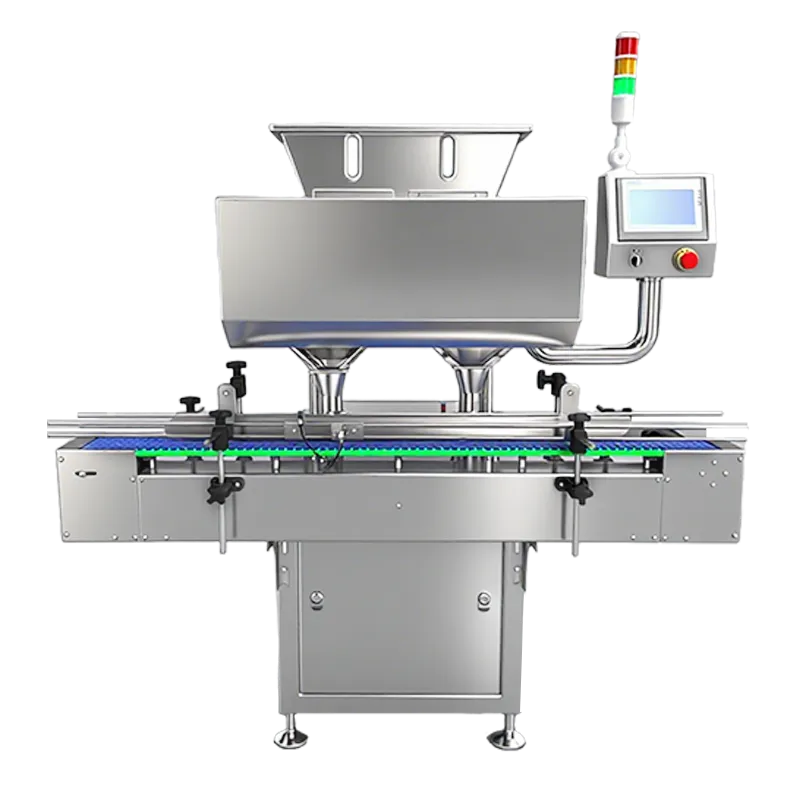
Definition and Core Purpose of Automatic Counting Machines
What Is an Automatic Counting Machine?
Automatic counting machines (ACMs) are industrial devices designed to count individual items like pills, capsules, or tiny parts with very little need for human involvement. These machines work by combining mechanical parts such as hoppers and vibrating plates along with either optical sensors or weight detection systems. The result? Speeds that can go well beyond 1,000 units every minute. Manual counting methods typically come with around 5 to 8 percent errors when dealing with large volumes according to data from Manufacturing Efficiency Institute back in 2023. ACMs completely remove the risk of mistakes caused by worker fatigue and provide almost flawless accuracy instead.
How Automatic Counting Machines Improve Industrial Efficiency
When repetitive tasks get automated through ACM technology, the error rate drops dramatically - we're talking around 99.5% fewer mistakes than when people do the counting manually (Global Pharmaceutical Review, 2023). The financial impact is pretty substantial too. Facilities that have made the switch are seeing their material waste cut down somewhere between 30% to 40%, plus they spend a lot less on labor. Take one pharmaceutical factory that brought ACMs onto their packaging line last year. They managed to slash downtime by nearly a quarter while boosting daily production numbers by about 15% (McKinsey & Company, 2024). What's really nice about these systems is how they work hand in hand with existing inventory software. This connection allows managers to track what's happening on the production floor in real time, giving them much better control over day to day operations without constantly running back and forth checking things.
The Shift from Manual to Automated Counting in Manufacturing
The manufacturing sector is jumping on board with ACM technology mainly because they need to follow those GMP regulations. According to recent numbers, around three quarters of manufacturers have switched to automated systems for important jobs such as counting pills accurately something that used to cause all sorts of problems when done by hand and often resulted in fines from regulators. Industry reports from last year show that nearly two thirds made the switch specifically to cut down on contamination issues during production runs and avoid those dreaded audit problems. What we're seeing here isn't just about following rules though. There's definitely a bigger movement happening across industries where companies want to automate any process prone to mistakes so they can keep up with customers who demand better tracking capabilities, higher accuracy rates, and overall improved product quality standards especially in fields like medicine manufacturing and electronic component assembly.
Key Components and Technology Behind Automatic Counting Machines
Essential Components: Hopper, Sensors, and Counting System
Every automatic counting machine relies on three core components:
- Hoppers — Funnel-shaped containers that regulate bulk product flow into the counting zone, often equipped with baffles to prevent jams
- Sensors — Optical, weight-based, or laser systems that detect individual items at speeds up to 1,200 units/minute (Industrial Automation Report 2023)
- Counting System — Microprocessor-driven mechanisms that validate sensor data using pre-programmed weight-to-count ratios
| Component | Function | Impact on Accuracy |
|---|---|---|
| Hopper | Controls input flow | Reduces overfeeding errors by 62% |
| Sensors | Item detection | Ensures 99.9% detection rate |
| Processor | Data validation | Eliminates 97% of miscounts |
Product Flow Management: Vibratory Plates and Conveyor Systems
Vibratory plates use controlled oscillations to separate clustered items before they enter the counting zone. Conveyor systems then transport products at adjustable speeds (5—30 ft/min), aligning them into single-file streams for reliable detection. Together, these technologies reduce bottlenecks by 83% compared to gravity-fed models, ensuring consistent throughput.
Sensor Technologies for Reliable Detection and Counting
Pharmaceutical-grade machines utilize hybrid detection systems:
- Optical sensors verify tablet dimensions against stored profiles
- Weight sensors cross-check batches with sensitivity down to 0.001g
- Infrared scanners detect translucent capsules missed by visible-light systems
Recent advances in multi-spectral imaging enable simultaneous verification of count integrity and quality indicators such as coating defects, enhancing both accuracy and quality control.
Control Panels and Software Interfaces for Operational Control
Modern interfaces feature tactile controls and 7" touchscreen displays showing real-time metrics including batch completion percentage, error rate per 1,000 units, and predictive maintenance alerts. Password-protected software supports GMP compliance by generating audit trails that document every parameter and result from each counting session.
Types and Classifications of Automatic Counting Machines
Automatic counting machines are categorized by automation level, specialized function, and adaptability. Understanding these classifications helps manufacturers select solutions aligned with their production scale and complexity.
By Automation Level: Manual, Semi-Automatic, and Fully Automatic Systems
Counting machines fall into three tiers based on operator involvement:
- Manual systems require operators to feed materials and monitor outputs, suitable for low-volume batches (<500 units/hour).
- Semi-automatic models perform autonomous counting but need human input for bottle placement or refilling, achieving speeds of 1,200—2,000 units/hour.
- Fully automatic systems handle end-to-end operations—including counting, filling, and sealing—with over 99.5% accuracy (Ponemon 2023), making them ideal for high-speed pharmaceutical lines.
Specialized Machines: Tablet vs. Capsule Counting Solutions
Dedicated designs address shape-specific challenges:
- Tablet counters rely on weight-based sensors or vibratory channels optimized for flat, round pills.
- Capsule counters use optical sensors tuned to distinguish cylindrical shapes and prevent misalignment or double-counting.
Dual-Function and Modular Automatic Counting Machines
Hybrid systems combine counting with filling or sealing functions, reducing required floor space by 30—40%. Modular configurations allow quick swapping of components like hoppers or sensors, enabling adaptation to new products without full system replacement.
Trend: Flexible, Modular Designs for Dynamic Production Lines
Scalability is a key focus—67% of manufacturers now deploy machines with interchangeable parts for rapid format changes (GMP Standards 2023). This flexibility supports small-batch production and cuts retooling costs by 25%, improving responsiveness in dynamic manufacturing environments.
Working Principles and Real-World Performance
How Automatic Tablet and Capsule Counting Machines Work
Automatic Counting Machines (ACMs) make pharmaceutical packaging much more efficient by following three main steps: loading products, counting them accurately, then sealing them properly. When tablets or capsules enter the system, they come from a hopper down onto what looks like a vibrating conveyor belt. This special plate gets all those little pills lined up nice and neat in straight rows ready for inspection. High tech optical sensors check every piece as it goes by, making sure nothing slips through unnoticed. Some newer models even have built-in scales that double check the weight of oddly shaped medications where visual inspection alone might miss something. The computer inside compares what it sees against pre-programmed standards, tossing out anything that doesn't fit and keeping track of everything counted with nearly perfect accuracy according to recent studies published last year in PharmaTech Journal. These machines cut down on mistakes by almost all when compared to people doing the same job manually, which explains why so many pharmacies and manufacturers have switched over to automated solutions.
Case Study: High-Speed Counting in a Pharmaceutical Packaging Line
A 2023 implementation study at a European drug manufacturer demonstrated the impact of dual-channel ACMs:
- Throughput: 12,000 capsules/hour per line (+400% vs. manual counting)
- Waste Reduction: 92% fewer miscounted batches
- Compliance: Zero GMP violations during 18-month audits
Predictive maintenance algorithms reduced unplanned downtime by 62%, highlighting how modern systems enhance both productivity and regulatory compliance.
Balancing Speed and Accuracy in Real-Time Operations
Top-tier ACMs use adaptive speed controls that automatically slow feeding when sensors detect irregularities in product dimensions. This dynamic adjustment maintains accuracy above 99.8% even at peak speeds of 800 units/minute. Real-time dashboards let operators monitor throughput and error rates, allowing immediate adjustments without halting production.
Challenges: Precision with Irregularly Shaped Pills
Standard tablets are easily counted, but crescent-shaped or scored pills pose challenges. Advanced models overcome this with:
- 3D Laser Profiling: Maps pill geometry to fine-tune counting logic
- Multi-Sensor Fusion: Integrates weight, optical, and spectral data
- Deep Learning: Adapts recognition patterns over time through repeated exposure
These innovations have reduced discrepancies for complex shapes by 87% since 2020 (International Journal of Pharma Engineering), though experts still recommend occasional manual verification for high-risk formulations.
Benefits and Future Trends in Pharmaceutical Automation
Advantages: Accuracy, Speed, and Reduced Human Error
According to research from the Ponemon Institute in 2023, automated counting machines (ACMs) reach nearly perfect accuracy at 99.9% when used in pharmacies, which wipes out the roughly 7% mistakes people typically make manually. These machines aren't just accurate either they can tally around 2,500 pills every single minute, about eight times quicker than what any person could manage, plus they check tablet weights automatically to spot anything off track. Looking at actual results, companies that switched to these systems saw their product recall rates plunge by 62%. A real world example comes from some European vaccine packaging plants studied back in 2022 where this dramatic improvement was clearly observed.
Cost Savings and Compliance with GMP Standards
Facilities in the pharmaceutical industry that implement ACM systems typically cut their labor expenses by around $740k each year according to Ponemon's 2023 findings, while staying within just under 0.1% of GMP standards. The real game changer comes from those built-in audit trails and electronic batch records. Last year alone, these features allowed nearly 9 out of 10 users to breeze through FDA inspections without needing any follow-up visits. That's a stark contrast to traditional facilities still using paper-based processes where only about half managed to pass initial inspections according to the FDA's 2024 compliance data. Makes sense when we think about it the time saved and errors prevented definitely pay off in both regulatory compliance and bottom line savings.
Innovation Trend: AI and Predictive Maintenance in Counting Machines
AI-powered vision systems now detect microscopic tablet defects with 0.05mm resolution, adjusting counting parameters in real time. According to a 2024 MarketsandMarkets analysis, AI-enabled pharmaceutical automation is projected to grow 22% annually through 2029, driven largely by predictive maintenance features that cut downtime by 41% in capsule counting applications.
Future Outlook: IoT-Enabled Smart Factories and Next-Gen Counting Systems
The latest ACM models now come equipped with IoT sensors that help manage how materials move along packaging lines while sending live updates straight to ERP systems. According to some early users who've implemented these Industry 4.0 technologies, they're seeing around 19% boost in their production output based on figures from the International Society of Automation back in 2023. We're also starting to see modular systems pop up that can switch quickly from counting tablets to handling vials - something really important for companies dealing with over 150 different product codes. These kinds of flexible setups are changing how factories operate day to day, making them smarter and able to adapt faster when market demands shift unexpectedly.
FAQ
What are Automatic Counting Machines (ACMs)?
Automatic Counting Machines are devices designed to count individual items such as pills, capsules, or small parts without human intervention, utilizing mechanical parts, optical sensors, or weight detection systems to achieve high-speed and high-accuracy counting.
How do Automatic Counting Machines improve industrial efficiency?
ACMs reduce errors by around 99.5%, cut material waste by 30% to 40%, and decrease downtime while increasing productivity, working seamlessly with inventory software to enhance operational control.
What are the main components of Automatic Counting Machines?
ACMs consist of hoppers for regulating product flow, sensors for detecting items, and a counting system that validates sensor data for accurate counting.
What are the different types of Automatic Counting Machines?
ACMs are categorized by automation level into manual, semi-automatic, and fully automatic systems, along with specialized tablet and capsule counting solutions.
What are the future trends in pharmaceutical automation involving ACMs?
The integration of AI and IoT technologies, modular designs, predictive maintenance features, and smart factory capabilities are driving significant advancements in the efficiency and adaptability of ACMs for dynamic production environments.