 EN
EN

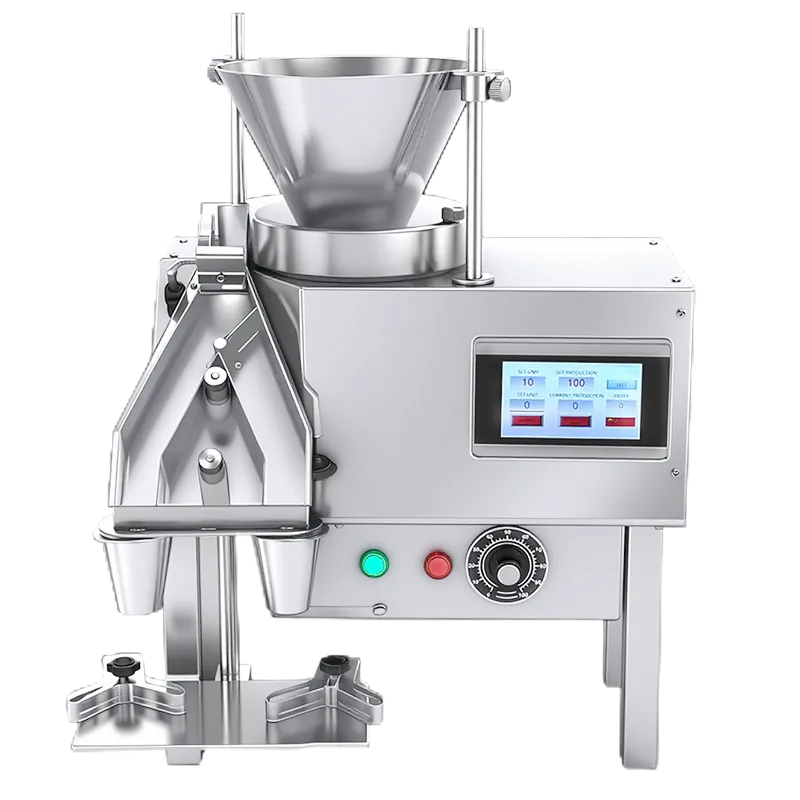
What Are Tablet Counting Machines? Core Functions and Working Principles
Definition and Primary Function of Tablet Counting Machines
Tablet counting machines work as automatic systems that count out exact numbers of pills, supplements, or other solid dose products. These devices basically exist to stop people from making mistakes when counting tablets by hand, which helps meet those strict GMP standards in pharmacies. According to research published by ISPE last year, humans tend to mess up about 1.2% of batches when counting manually. But these fancy machines? They hit around 99.9% accuracy thanks to sensors inside them and special feeding mechanisms that control vibrations during operation.
How Tablet Counting Machines Work: The Fundamental Working Principle
These machines operate through four synchronized stages:
- Feeding: Tablets flow from a hopper into a vibration tray that separates clumped units
- Alignment: Precisely angled channels orient tablets for consistent sensor detection
- Counting: Infrared/optical sensors verify each unit’s presence without physical contact
- Dispensing: Validated counts transfer to blister packs or bottles while rejection systems isolate defects
This process reduces counting time by 87% compared to manual methods according to automation benchmarks from leading manufacturers.
Key Components: Hoppers, Vibration Trays, Sensors, and Rejection Systems
| Component | Function | Impact on Accuracy |
|---|---|---|
| Stainless steel hopper | Stores bulk tablets pre-counting | Ensures consistent feed rate |
| Micro-adjusted vibration tray | Separates and aligns tablets | Prevents double-counting errors |
| Multi-spectrum sensors | Detects position, size, and surface defects | Flags 99.6% of abnormalities |
| Pneumatic rejectors | Removes misaligned or damaged units | Maintains batch integrity |
As shown in calibration trials by packaging engineers, proper component synchronization achieves ₠0.1% variance across 8-hour production runs.
Types of Tablet Counting Machines: Manual, Semi-Automatic, and Fully Automatic Systems
Manual Tablet Counting Machines: Operation and Limitations
With manual counting systems, staff members actually have to pour pills into trays one by one and count each tablet against those little grid plates they use. These setups work fine when volumes are really low, maybe under 100 tablets per day. But problems start popping up when dealing with oddly shaped pills, and according to some research from Ponemon back in 2023, mistakes happen more than 5 times out of 100 when mixing different batches together. The whole process depends so much on people watching carefully that it just doesn't scale well. Most pharmacies can't handle this kind of system if they need to fill over fifty prescriptions every hour during busy periods.
Semi-Automatic Systems: Balancing Control and Efficiency
Semi automatic machines that combine mechanical feeding trays and some basic sensors can process around 600 to 1000 tablets per minute. They let staff check the count before actually dispensing the medication. While these systems cut down on counting mistakes to about 2 or 3 percent compared with doing it all by hand, they still need someone to step in occasionally to restock the hopper or tweak the channel width settings. According to a recent look at automation trends in pharmacies from 2024, nearly a third (around 27%) of compounding pharmacies have gone with semi automatic options because they make switching between different sized tablets much easier without having to go through complicated reprogramming processes.
Fully Automatic Machines: Integration in Pharmaceutical Packaging Lines
Industrial models with multi-stage vibration trays, optical sensors, and PLC controls process 4,000–6,000 tablets/minute at <1% error rates. Integrated rejection gates automatically remove broken or misshapen tablets, while CIP (Clean-in-Place) systems meet FDA batch-cleaning requirements. These machines synchronize with blister packaging lines, enabling uninterrupted production of 10,000+ unit batches.
| System Type | Speed (Tablets/Min) | Accuracy | Ideal Use Case |
|---|---|---|---|
| Manual | 50–200 | 90–95% | Small clinics, trial batches |
| Semi-Automatic | 600–1,000 | 97–98% | Mid-size pharmacies |
| Fully Automatic | 4,000–6,000 | ₣¥99% | Large-scale manufacturing |
Data source: Pharmaceutical Automation Review 2024
Fully automatic systems incur 3-5x higher upfront costs than semi-automatic alternatives but achieve 98% lower labor expenses per 10,000 units processed. Facilities producing over 500,000 monthly doses typically see ROI within 18–24 months.
How Tablet Counting Machines Work: Operational Phases and Internal Mechanisms
Main Phases of Operation: Feeding, Alignment, Counting, and Dispensing
Tablet counting machines these days make production much smoother by going through about four main steps. First comes the feeding stage where tablets go into a hopper. Special vibrating trays guide them into a neat line one after another. The engineers really fine-tuned this part so tablets don't end up stacked on top of each other. Next up is when sensors kick in for counting. These can use either infrared light beams or weigh the tablets to get an accurate count, usually within around 0.25% error margin. Finally, the machine sends out the counted tablets into their packaging. Any damaged ones get separated automatically thanks to little air powered reject mechanisms that push them aside instead.
The Role of Vibration Trays, Channels, and Sensor Arrays in Precision Counting
The vibration levels and angle settings on these machines get adjusted based on how big the tablets are and how fragile they might be, which helps keep everything flowing smoothly without wearing down the product. These systems often have narrow channels where 2 or 3 extra sensors work together to check if each tablet is actually there, fixing problems that happen when two pills get counted as one. For the top tier equipment, manufacturers added something called spectral analysis that spots tiny cracks or color changes while the process is still running. Industry tests from last year show these advanced systems catch defects at rates over 99.2 percent, making them pretty reliable for quality control in pill production.
Detection Mechanisms: Ensuring Accuracy Through Advanced Sensor Technology
Validation systems these days often bring together several different technologies including weight verification, OCR scanning, and laser profiling techniques. When dealing with oddly shaped meds such as lozenges, manufacturers rely on 3D machine vision cameras that capture surface details at around 120 frames per second. The system then compares what it sees with stored CAD designs to spot any discrepancies. Most importantly, these setups automatically recalibrate themselves roughly every four hours by referencing built-in standard weights. This helps keep everything within the required USP 785 guidelines regarding particulate contamination levels that pharmaceutical companies must follow.
Trade-Offs Between Speed and Accuracy in High-Throughput Environments
Machines prioritizing speed (400+ tablets/minute) typically exhibit 0.5-1% higher error margins compared to precision-focused models (250 tablets/minute). In nutraceutical facilities handling uniform tablets, operators often favor speed-optimized configurations. Conversely, oncology drug manufacturers overwhelmingly choose accuracy-centric systems despite 18-22% slower throughput, as evidenced by 2022 FDA audit trends.
Accuracy, Calibration, and Sensor Technology in Modern Tablet Counting Machines
Factors Affecting Counting Accuracy and Operational Efficiency
In ideal conditions, most modern tablet counters hit around 99.9% accuracy according to Jinlu Packing's 2023 report. However when we look at actual operation on factory floors, factors such as vibrations from nearby machinery, inconsistent tablet sizes, and changes in air moisture tend to bring down the accuracy range somewhere between 97 and 98 percent. The trouble really starts with oddly shaped pills or ones that have rough textures on their surface. These often get stuck in the feeding mechanism, forcing workers to constantly tweak the vibration trays throughout production runs. Systems designed for high output rates over 500 tablets per minute encounter even bigger problems because they simply don't have time to properly register each tablet before moving onto the next one, leading to occasional double counts or missed items altogether.
Advanced Sensors and Error-Detection Systems for Reliable Performance
Top manufacturers are starting to incorporate these fancy multi layer sensor setups that mix optical cameras with infrared tech and some sort of weight check system too. The high res vision stuff can spot chips, cracks or weird colors really fast actually around 800 tablets per minute give or take. When it finds something wrong, those bad ones get pushed out by these little air powered arms. Some newer machines have gotten smart with AI algorithms that tell the difference between tablets stuck together and actual double counts. This cuts down on mistakes quite a bit probably somewhere around 40% less errors than what we saw with older optical sensors back in the day.
Calibration and Validation Processes for Consistent, Compliant Output
Regular calibration keeps sensor readings within that crucial ±0.5% range day after day. The automated machinery actually has built-in recipes for all sorts of tablets, so when switching between products, it can tweak things like track width and vibration frequency in under 15 seconds flat. After counting happens, there's still work to be done. We check weights and sometimes do spot checks manually too, which is necessary if we want to comply with those tough regulations from both EU GMP Annex 11 and FDA 21 CFR Part 11. Most facilities run three hour long validation tests using dummy tablets as part of their routine maintenance. These tests generate error logs that get looked at every quarter to improve the counting software over time.
Applications and Industry Use Cases: From Pharmaceuticals to Nutraceuticals
Pharmaceutical applications: Automation in packaging and batch control
Pharma companies just can't do without tablet counting machines these days since getting the count right really matters when it comes to keeping patients safe. The numbers tell a story too bad for manufacturers who make mistakes in packaging medications. A recent study from Ponemon Institute found that errors here end up costing around $740k each year through recalls and all sorts of legal headaches. These newer counting systems work hand in glove with blister packs and those vial filling stations out there on the factory floor. They automate batches and still manage to hit within half a percent accuracy most of the time. And let's face it, this kind of reliable performance is what keeps the FDA happy with their 21 CFR Part 11 rules about record keeping. Every single production run gets documented properly so nothing slips through the cracks during audits.
Handling diverse tablets and capsules: Size, shape, and formulation flexibility
Top companies in the industry build tablet counters that work with everything from tiny 2mm micro-tablets all the way up to those big 25mm chewable capsules, and they don't need any special parts swapped out for different sizes. These machines come equipped with smart optical sensors that actually tell apart pills that look almost identical in color. There's also something called capacitive detection built in, which stops the machine from getting confused when it encounters those clear gelatin capsules that can be tricky to count accurately. Most systems today are pretty versatile too, handling around 30 different product types usually, so when a manufacturer needs to switch between various nutraceutical products during production, they can do it quickly without much downtime.
Beyond pharma: Use in nutraceuticals, veterinary, and consumer health sectors
The rising interest in customized vitamins and pet meds means these capsule filling machines are finding new roles beyond traditional pharmacies. Many vet offices have started using compact benchtop versions to mix just the right amount of medication for different animals. Meanwhile, big industrial machines churn out thousands of omega-3 softgels and probiotic capsules every hour, some running at speeds over 50k per hour. Looking ahead, the nutraceutical industry is expected to hit around $722 billion by 2032 according to recent forecasts. This growth has manufacturers looking for equipment that can handle everything from small batches to large scale production across all sorts of health products.
FAQ
What are the main types of tablet counting machines?
The main types are manual, semi-automatic, and fully automatic tablet counting machines.
What is the accuracy rate of modern tablet counting machines?
Modern tablet counting machines have an accuracy rate of around 99.9% under ideal conditions.
How do tablet counting machines ensure accuracy?
They use advanced sensors, including infrared/optical sensors and weight verification systems, to ensure accurate counts and detect defects.
What are the applications of tablet counting machines?
They are used in pharmaceuticals, nutraceuticals, veterinary medicine, and consumer health sectors for precise counting and packaging of tablets and capsules.
Table of Contents
- What Are Tablet Counting Machines? Core Functions and Working Principles
- Types of Tablet Counting Machines: Manual, Semi-Automatic, and Fully Automatic Systems
- How Tablet Counting Machines Work: Operational Phases and Internal Mechanisms
- Accuracy, Calibration, and Sensor Technology in Modern Tablet Counting Machines
- Applications and Industry Use Cases: From Pharmaceuticals to Nutraceuticals
- FAQ