 EN
EN


Why Food Manufacturers Are Switching to Automated Counting
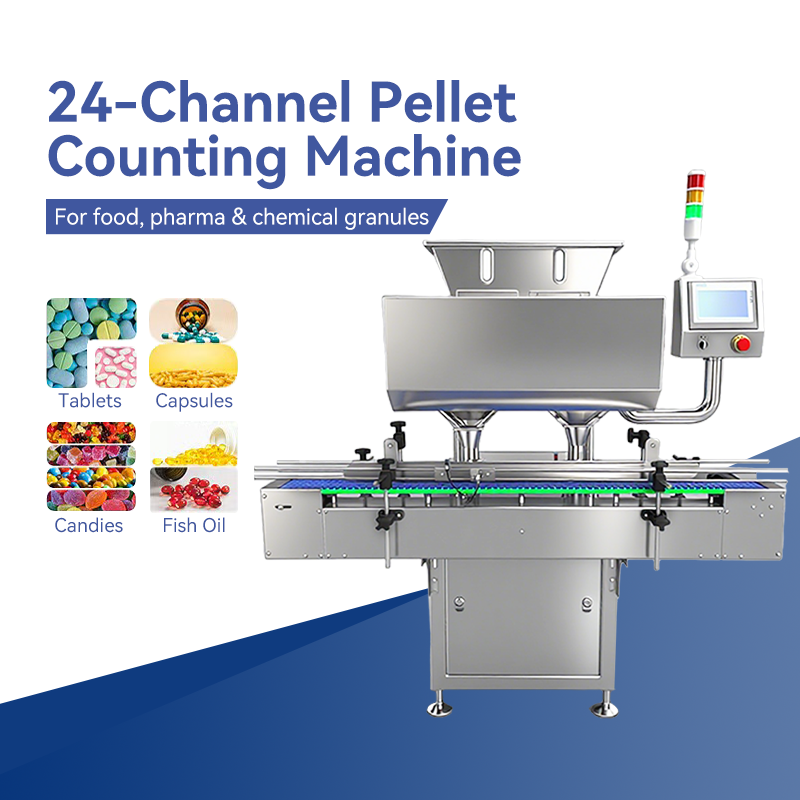
The global food packaging equipment market has seen a fundamental shift toward automation, driven by tightening food safety regulations, rising labor costs, and consumer demand for consistent portion accuracy. Automatic counting machines — long established in pharmaceutical manufacturing — are now seeing rapid adoption across the confectionery, dietary supplement, frozen food, and dry goods sectors. What once required 4 to 6 manual packing line workers can now be accomplished with a single counting machine operator overseeing a line that processes 40 to 120 bottles per minute.
Food-grade counting machines differ from their pharmaceutical counterparts in critical ways. Contact surfaces must be manufactured from 304 or 316L stainless steel to resist corrosion from acidic food products and withstand frequent washdown cycles. Gaskets, seals, and lubricants must be food-grade certified. And the machine's control system must support rapid product changeovers — a confectionery manufacturer might run gummy vitamins in the morning, hard candy in the afternoon, and coated nuts in the evening, all on the same counting line.
Ruiyi Machinery's automatic counting machines are engineered with these requirements in mind. With CE certification and ISO 9001 quality management, and manufactured using food-grade 304 stainless steel for all product-contact surfaces, the company's equipment meets the hygiene standards demanded by food safety authorities across its 50+ export markets, from Southeast Asia to South America.
Food Safety Compliance: Material, Design, and Cleaning Standards
Material Requirements for Food-Grade Counting Equipment
Food safety begins with material selection. The U.S. FDA's 21 CFR Part 110 and the EU's Regulation (EC) No. 1935/2004 establish strict requirements for materials that contact food products during manufacturing and packaging. Automatic counting machines used in food applications must meet the following material standards as a minimum baseline:
- Product contact surfaces: 304 or 316L stainless steel with a surface finish of Ra ≤ 0.8 µm. The smooth finish prevents bacterial adhesion and makes cleaning more effective. Ruiyi Machinery's counting channels, vibratory trays, and discharge chutes are constructed from 304 stainless steel as standard.
- Non-contact structural components: 304 stainless steel or anodized aluminum with sealed surfaces. Painted mild steel is not acceptable in food production environments due to the risk of paint chip contamination.
- Seals and gaskets: FDA-compliant silicone or EPDM rubber rated for repeated CIP (Clean-in-Place) or manual washdown with food-grade detergents.
- Lubricants: NSF H1 registered food-grade lubricants for all points where incidental food contact is possible.
Hygienic Design Principles
Beyond material selection, the machine's physical design determines how effectively it can be cleaned between production runs. Hygienic design principles for food counting equipment include sloped surfaces that prevent liquid pooling, rounded internal corners with a minimum radius of 3 mm to eliminate crevices where product residue accumulates, and tool-free disassembly of all product-contact components for daily cleaning access.
Ruiyi Machinery's counting equipment incorporates quick-release fasteners on the infeed hopper, counting channels, and discharge assembly, enabling operators to disassemble, clean, and reassemble all food-contact components in under 15 minutes — a design feature that directly supports compliance with HACCP prerequisite programs requiring documented cleaning between allergen-containing product runs.
Counting Accuracy for Different Food Product Types
Food products present unique counting challenges that do not exist in pharmaceutical tablet counting. Unlike uniform pharmaceutical tablets manufactured to tight dimensional tolerances, food products — especially natural products like nuts, dried fruits, and freeze-dried vegetables — exhibit significant variation in size, shape, and weight. The counting machine must adapt its sensor parameters and feed rate to accommodate this variability without sacrificing accuracy.
| Product Category | Typical Unit Size Range | Target Counting Accuracy | Recommended Ruiyi Machine Configuration | Common Challenges |
|---|---|---|---|---|
| Confectionery (hard candy, gummies) | 8–25 mm diameter | ±0.1% (photo-electric counting) | Standard counting wheel with vibratory feeder; medium speed (60–80 bpm) | Sugar dust accumulation on sensors; sticky residue on feed surfaces during humid weather |
| Dietary supplements (softgels, caplets) | 6–22 mm length | ±0.1% (photo-electric counting) | Multi-channel counting head; high speed (80–120 bpm) | Softgel deformation in high-temperature environments; static electricity causing product sticking |
| Freeze-dried products (fruit pieces, vegetables) | 5–35 mm irregular | ±1.0% (photo-electric with adaptive algorithm) | Wide-channel counting head with reduced vibration amplitude; low speed (30–50 bpm) | Irregular product shape causes sensor shadowing; fragility requires gentle handling to reduce breakage |
| Dry goods (coffee pods, tea bags, seasoning sachets) | 30–60 mm flat packs | ±0.2% (infrared sensor array) | Custom counting channel width; medium speed (50–70 bpm) | Product overlapping in feed channel; inconsistent spacing on vibratory tray |
| Nuts and seeds (almonds, cashews, sunflower seeds) | 3–25 mm irregular | ±1.5% (weigh-count hybrid mode) | Combined counting-weighing module; low speed (25–40 bpm) | Oil residue contaminating sensors; large unit-to-unit weight variation confounding pure count-based filling |
Regulatory Landscape: HACCP, BRC, and FSSC 22000 Implications
Food manufacturers operating in export markets face an increasingly complex regulatory environment. The Global Food Safety Initiative (GFSI) — which benchmarks certification schemes including BRCGS, FSSC 22000, and IFS Food — requires that food packaging equipment be designed, installed, and maintained in a manner that prevents physical, chemical, and microbiological contamination of the product. An automatic counting machine sits at the final quality checkpoint before the product reaches the consumer, making it a focus area during third-party food safety audits.
Key audit points for counting equipment under GFSI-benchmarked standards include:
- Documented cleaning procedures with defined frequency, method, and responsible personnel — records must be maintained and available for auditor review
- Preventive maintenance logs demonstrating that counting sensors are calibrated at defined intervals and that calibration results fall within acceptance criteria
- Metal detection or X-ray inspection integration — the counting machine must be positioned upstream of the final inspection point, and any foreign body detection event must trigger an automatic line stop with documented investigation
- Allergen control validation — if the counting line runs products containing different allergens (e.g., nut-containing products followed by nut-free products), the cleaning procedure between runs must be validated through surface swab testing for allergen protein residues
Ruiyi Machinery's equipment supports these compliance requirements through hygienic machine design, clear documentation packages that include material certificates for all food-contact components, and compatibility with standard third-party metal detection and checkweighing equipment commonly integrated into food packaging lines.
Cost-Benefit Analysis: Manual vs. Automated Counting in Food Production
For a typical food production line running a single 8-hour shift, 250 days per year, the economics of automated counting are compelling. A manual packing station requiring 4 workers at an average labor cost of $4.50 per hour (reflective of manufacturing wages in Southeast Asian markets commonly served by Ruiyi Machinery) incurs an annual labor cost of approximately $36,000. A single automatic counting machine operated by 1 worker reduces this cost to $9,000 per year — a $27,000 annual saving before accounting for productivity gains.
Beyond direct labor savings, automated counting delivers additional financial benefits that are often overlooked in simple payback calculations:
- Overfill reduction: Manual counting typically results in 2% to 5% overfill as workers err on the side of caution. At a product cost of $5 per kilogram and an annual throughput of 200 metric tons, a 3% overfill rate wastes $30,000 in product value annually. Automated counting at ±0.1% accuracy virtually eliminates this loss.
- Throughput increase: An automatic counting line typically processes 3 to 5 times more bottles per hour than a manual packing station. For manufacturers experiencing demand growth, automation enables capacity expansion without additional floor space or headcount.
- Quality-related cost avoidance: A single customer complaint about short-filled product can trigger a retailer audit, delisting, or in the worst case, a product recall. The average cost of a food product recall is estimated at $10 million in direct costs alone, not including long-term brand damage (Food Marketing Institute & Grocery Manufacturers Association, 2023).
Installation Example: Counting Line for a Southeast Asian Nutraceutical Manufacturer
A recent installation by Ruiyi Machinery for a dietary supplement manufacturer in Thailand illustrates the practical benefits of automated counting in food applications. The customer — a producer of herbal supplement capsules sold in bottles of 60, 90, and 120 counts across Thailand, Vietnam, and Cambodia — replaced two manual packing lines with a single Ruiyi fully automatic counting machine integrated with an automatic capping machine and induction sealing system.
Key results after 12 months of operation:
- Production throughput increased from 800 bottles per 8-hour shift (manual) to 4,200 bottles per shift (automated) — a 425% improvement.
- Counting accuracy improved from an estimated ±3% (manual, based on periodic weight checks) to a verified ±0.1% (automated, based on continuous sensor verification).
- The customer reported zero customer complaints related to short fills in the 12 months following automation, compared to an average of 6 to 8 complaints per year under manual counting.
- Total labor on the packing line was reduced from 8 workers (2 shifts × 4 workers) to 2 workers (1 operator plus 1 quality inspector per shift).
- Return on investment was achieved in 14 months, calculated based on direct labor savings, overfill reduction, and avoided quality-related costs.
Selecting the Right Counting Machine for Your Food Application
Choosing a counting machine for food production requires evaluating factors beyond simple throughput specifications. The following decision criteria should guide your selection process:
- Product characteristics: Physical dimensions, surface texture (sticky, dusty, oily), friability, and hygroscopicity all influence counting method selection and machine configuration.
- Production environment: Facilities with high ambient humidity require machines with sealed electronics and corrosion-resistant components. Facilities subject to washdown procedures require IP65 or higher ingress protection ratings on electrical enclosures.
- Changeover frequency: Manufacturers running 5 or more product SKUs per day on the same line should prioritize machines with recipe-based parameter storage and tool-free changeover features that reduce downtime between runs to under 10 minutes.
- Integration requirements: The counting machine must communicate with upstream equipment (bottle unscrambler, desiccant inserter) and downstream equipment (capping machine, labeling machine, checkweigher) through standard industrial protocols.
- Regulatory jurisdiction: Equipment destined for the EU market must carry CE marking; equipment for FDA-regulated markets must comply with 21 CFR Part 11 requirements for electronic records and signatures if the counting data forms part of the batch record.
Request a Product-Specific Counting Trial
Hangzhou Ruiyi Machinery Technology Co., Ltd. offers complimentary counting trials using your actual product samples. Send us a 500-gram sample of your product, and our application engineering team will run a counting accuracy test and provide a detailed report including recommended machine configuration, expected throughput, and accuracy data at no cost.
tel: +86-13868159610
email: [email protected]
Data sources: Food Marketing Institute & Grocery Manufacturers Association Recall Cost Study, 2023; EU Regulation (EC) No. 1935/2004; FDA 21 CFR Part 110; GFSI Benchmarking Requirements Version 2024.
Table of Contents
- Why Food Manufacturers Are Switching to Automated Counting
- Food Safety Compliance: Material, Design, and Cleaning Standards
- Counting Accuracy for Different Food Product Types
- Regulatory Landscape: HACCP, BRC, and FSSC 22000 Implications
- Cost-Benefit Analysis: Manual vs. Automated Counting in Food Production
- Installation Example: Counting Line for a Southeast Asian Nutraceutical Manufacturer
- Selecting the Right Counting Machine for Your Food Application